Homi Bhabha Exam Result Trends: What Past Cutoffs Tell Us About 2026
In this blog, you will learn about Homi Bhabha Exam result trends, explore past Homi Bhabha cutoffs, understand what previous cutoff patterns reveal, and see what they could mean for the Homi Bhabha Exam 2026.

By Chaitanya Vaze
Chaitanya Vaze is a leading educator and author with 26 years of experience in mentoring students for the Dr. Homi Bhabha Young Scientist Exam. Based in Dombivali, he runs a premier guidance center for Homi Bhabha, Scholarship, Olympiad, and NMMS exams. He is widely recognized for his "complete toolkit" approach to science, including: Author of 15+ Books: Creator of the definitive Theory and Practical science Handbooks for Std. 6th and 9th. Practical Innovation: Developer of "Smart Kits" that help students master the Level 2 Practical Exam at home. Latest Release: He is currently authoring the newest editions for Year 6 & 9, featuring updated practice questions and concise learning summaries (launching next month!).
Table of Contents:
Introduction
What Is the Homi Bhabha Exam?
What the Homi Bhabha Exam Result Trend Means for 2026 Preparation
Homi Bhabha Exam Result 2023: What the Cutoff Tells Us
Homi Bhabha Result 2024: Did the Cutoff Move Up or Down?
Why Homi Bhabha Cutoffs Change Every Single Year
What Does the Homi Bhabha Score Analysis Tell Students?
Where Most Students Actually Lose Marks
Can Past Results Help With Homi Bhabha Result Prediction for 2026?
3 Myths That Make Parents Misread Cutoff Data
How Nitome Helps You Prepare Beyond the Homi Bhabha Result
Final Verdict
Frequently Asked Questions
Key Takeaways
|
The moment the Homi Bhabha exam ends, one question starts coming to every student’s mind: “Did I score enough to qualify?” They look at their estimated marks to understand their chances of qualifying. Previous results as well as cutoff patterns can provide useful context that is crucial while comparing the Homi Bhabha exam result 2023 with the Homi Bhabha result 2024.
Key points to consider:
- Homi Bhabha result history shows how qualifying marks have changed over time.
- Homi Bhabha score analysis helps students compare their performance with past trends.
- The Homi Bhabha exam result trend indicates whether cutoffs are rising or falling.
- A Homi Bhabha result prediction for 2026 should also consider paper difficulty, competition and category-wise cutoffs.
By studying these factors together, students can form a more realistic idea of their expected result instead of relying on marks alone.
What Is the Homi Bhabha Exam?
The Dr. Homi Bhabha Balvaidnyanik Competition has been conducted by the Greater Bombay Science Teachers’ Association (GBSTA) since 1981. It is a unique four-stage science competition designed for students in Classes 6 and 9. It aims to arouse curiosity, develop a problem-solving attitude and strengthen precision in observational and motor skills among young scientists. The competition encourages students to apply scientific concepts beyond textbooks.
What the Homi Bhabha Exam Result Trend Means for 2026 Preparation
- Use past Homi Bhabha results as a preparation benchmark, not as a fixed target.
- Compare your practice-test scores with past Homi Bhabha exam result trends to track improvement.
- If your scores are close to the cutoff, work on weak science concepts, accuracy and time management.
- Practice with previous papers as well as mock tests that will improve your preparation.
- Take historical cutoffs as a reference, not a guarantee of the Homi Bhabha result prediction for 2026 as the benchmark changes each year.
Homi Bhabha Exam Result 2023: What the Cutoff Tells Us
The Homi Bhabha exam result of 2023 gives an important starting point for understanding how competitive the written stage can be. The 2023 data is useful for Homi Bhabha score analysis and provides a reference point when studying how cutoffs moved in later years.
|
Class |
Category |
Highest Cutoff |
Lowest Cutoff |
|
Class 6 |
SSC English |
47.5 |
34.2 |
|
Class 6 |
SSC Marathi |
45.4 |
26.5 |
|
Class 6 |
Other Boards |
48.4 |
38.8 |
|
Class 9 |
SSC English |
42.7 |
24.9 |
|
Class 9 |
SSC Marathi |
35.7 |
21.0 |
|
Class 9 |
Other Boards |
45.2 |
32.3 |
Homi Bhabha Result 2024: Did the Cutoff Move Up or Down?
The Homi Bhabha result 2024 provides a useful benchmark for understanding how competitive the written examination was across different regions and student categories. The official 2024–25 cutoff data shows that the qualifying benchmark varies by several factors rather than following one common cutoff across all students.
|
Region |
Medium & Board |
Class 6 Cutoff |
Class 9 Cutoff |
|
Mumbai |
English – SSC |
56 |
44 |
|
Thane |
English – SSC |
59 |
46 |
|
Pune |
English – SSC |
64 |
53 |
|
Kolhapur |
English – SSC |
61 |
55 |
|
Nashik |
English – SSC |
58 |
47 |
|
C. S. Nagar |
English – SSC |
54 |
49 |
|
Vidarbha |
English – SSC |
58 |
51 |
|
Latur |
English – SSC |
57 |
54 |
|
Others |
English – SSC |
42 |
43 |
Why Homi Bhabha Cutoffs Change Every Single Year
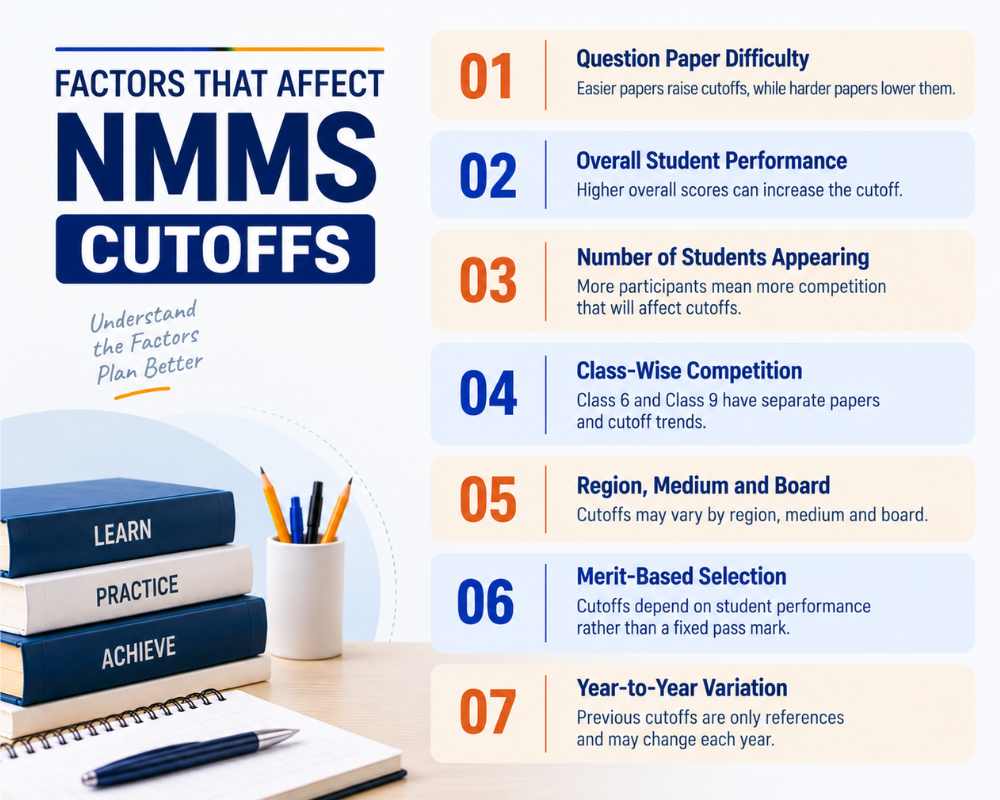
Cutoffs can move from one year to another because the Homi Bhabha competition is merit-based, so the benchmark depends on how students perform in that particular examination. Here are some of the reasons why it changes every year.
- Question Paper Difficulty: Easier papers raise cutoffs, while harder papers lower them.
- Overall Student Performance: Higher overall scores can increase the cutoff.
- Number of Students Appearing: More participants mean more competition that will affect cutoffs.
- Class-Wise Competition: Class 6 and Class 9 have separate papers and cutoff trends.
- Region, Medium and Board: Cutoffs may vary by region, medium and board.
- Merit-Based Selection: Cutoffs depend on student performance rather than a fixed pass mark.
- Year-to-Year Variation: Previous cutoffs are only references and may change each year.
What Does the Homi Bhabha Score Analysis Tell Students?
Your score analysis gives you a realistic idea of where you stand but it is not a guarantee of selection. It helps you understand your preparation, identify gaps and decide what to improve next.
- See how close your score is to previous cutoffs.
- Track whether your performance is improving.
- Identify your strong and weak science topics.
- Understand whether you have a safe score margin.
- Decide if you need to change your preparation strategy.
- Remember that cutoffs and competition can change every year.
- Estimate how well you manage time during the examination.
- Identify the types of questions where you lose the most marks.
Where Most Students Actually Lose Marks
Even students who understand the concepts can lose marks in the Homi Bhabha exam because of small, avoidable errors. Looking at where marks are lost is more useful than looking at the final score alone.
1. Misreading the Question
Students sometimes select an answer too quickly without noticing words such as “not,” “incorrect,” “except” or “most appropriate.”
2. Confusing Similar Scientific Concepts
Questions test closely related concepts and relying on memorized definitions instead of understanding the difference can lead to incorrect answers.
3. Calculation and Unit Errors
A student knows the correct method but loses the mark because of a calculation mistake, incorrect unit or nervousness that leads to rushed last minutes.
4. Overthinking Familiar Questions
Spending too much time looking for a hidden trick can make students change a correct answer unnecessarily.
5. Poor Time Management
Getting stuck on one difficult question can leave less time for questions that could have been answered correctly.
6. Guessing Without Eliminating Options
When students are unsure, choosing an option immediately can reduce accuracy. Eliminating clearly incorrect choices first can make the decision more informed.
7. Careless Marking or Answer Selection
In a multiple-choice paper, selecting the wrong option despite knowing the answer is one of the easiest marks to lose and one of the easiest mistakes to prevent.
Can Past Results Help With Homi Bhabha Result Prediction for 2026?
Past results help students estimate where the 2026 Homi Bhabha cutoff might fall, but they cannot predict the exact number. Cutoffs are useful because they show how the benchmark has moved over time, while the difficulty of the 2026 paper with overall student performance can still change the outcome.
Use the Trend, Not Just the Last Year
Instead of relying only on the previous year's cutoff, compare the cutoffs from the last two or three years. This helps you understand whether the cutoff has generally increased, decreased or remained constant.
Cutoff Trend = Recent Cutoff − Earlier Cutoff
For example, if the cutoff increased from 52 marks to 56 marks:
56 − 52 = +4 marks
This means the cutoff increased by 4 marks. If the cutoff has increased in more than one year, students may expect a slightly higher benchmark for 2026. However, this is only an estimate because the difficulty level and student performance can vary each year.
Compare Your Expected Score
You can also compare your expected score with the previous cutoff to see how comfortably you are reaching the cutoff.
Score Difference = Your Expected Score − Previous Cutoff
For example, if you expect to score 68 marks and the previous cutoff was 62 marks:
68 − 62 = +6 marks
This means your expected score is 6 marks above the previous cutoff. A difference can indicate a stronger position but it does not guarantee selection. Use this comparison to set a safe target so that you can continue preparing for a higher score.
3 Myths That Make Parents Misread Cutoff Data
Cutoff numbers can look simple, but they do not always tell the full story. Parents may see one number online and immediately use it to judge their child’s chances. Here are three common myths that should be cleared.
My child scored above last year's cutoff, so they are safe.
Not necessarily. You are comparing this year's new score to last year's cutoff. So this year's paper may be different, so the cutoff may change too.
The exam is only for toppers; an average student won't clear it.
This is not true. The cutoff may vary and students do not always need exceptionally high marks to qualify. Regular, focused revision matters more than being a genius.
We'll start preparing in Class 9; no need to start early.
Starting early helps. The Class 6 exam covers Class 4–6 topics, while the Class 9 exam covers Class 7–9 topics. Strong basics make it easier to clear the next stage and perform well in the practical and interview rounds.
How Nitome Helps You Prepare Beyond the Homi Bhabha Result
Getting the Homi Bhabha result is not the end of preparation. It helps students to understand their strengths as well as weaknesses by identifying areas for improvement. We support continued learning through digital tools that help students practise, review their performance and understand questions better. There are the following reasons for choosing us, as we provide:
- Digital workbooks: Helps students to make a structured study plan.
- Topic-wise analysis: They can identify where marks are being lost.
- Practice tests: Helps in checking performance under exam-like conditions.
- Score reports: Helps track progress against previous attempts.
- AI explanations: You can understand why an answer is correct.
Final Verdict
A cutoff list is a rearview mirror for students and parents that is useful to understand how cutoffs have changed over the years. The students who cleared Homi Bhabha's later exam are not the ones who memorized last year's number; they are the ones who built topic-wise fundamentals early, practiced under real exam-timing pressure and treated every mock test as a real paper.
Ready to prepare smarter for Homi Bhabha?
Explore Nitome’s digital workbooks and practice tests to strengthen your preparation, track your performance and understand where you can improve.
Frequently Asked Questions about Homi Bhabhi Exam Results Trends
1. Is the Homi Bhabha Exam easy or tough?
The Homi Bhabha Exam is generally challenging because it tests conceptual understanding, application and problem-solving rather than simple memorization.
2. How to score good marks in Homi Bhabha in 2026?
Focus on your Class 6 or 9 science syllabus, practice previous papers and take regular mock tests. Review your mistakes to improve accuracy and time management.
3. How can I compare my Homi Bhabha score with previous years?
Compare your score with official cutoff data from the same class, region, medium and board. This gives you a more relevant picture than comparing your marks with a general cutoff.