Homi Bhabha Science Olympiad vs. Other Science Olympiads: Which One to Choose?
In this blog, you will compare the Homi Bhabha Science Olympiad with other popular science olympiads, understand their key differences, eligibility and exam patterns, and learn which competition may be the right fit for your child.

By Chaitanya Vaze
Chaitanya Vaze is a leading educator and author with 26 years of experience in mentoring students for the Dr. Homi Bhabha Young Scientist Exam. Based in Dombivali, he runs a premier guidance center for Homi Bhabha, Scholarship, Olympiad, and NMMS exams. He is widely recognized for his "complete toolkit" approach to science, including: Author of 15+ Books: Creator of the definitive Theory and Practical science Handbooks for Std. 6th and 9th. Practical Innovation: Developer of "Smart Kits" that help students master the Level 2 Practical Exam at home. Latest Release: He is currently authoring the newest editions for Year 6 & 9, featuring updated practice questions and concise learning summaries (launching next month!).
Table of Contents:
Introduction
What Is the Homi Bhabha Science Olympiad?
What Makes Homi Bhabha Different
Which Is the Best Science Olympiad in India?
What the "Other" Olympiads Offer
Homi Bhabha vs NSO (Side-by-Side Comparison)
Homi Bhabha vs NTSE: Are They the Same Type of Exam?
Which Science Olympiad Should Maharashtra Students Choose?
How to Prepare Without Burning Your Child Out
How Nitome Can Help You Prepare for the Homi Bhabha Science Olympiad
Final Note
Frequently Asked Questions
Key Takeaways
|
This is something nobody tells you before you search for the Homi Bhabha Science Olympiad. Not every science Olympiad is meant for the same student and choosing the one that is popular among students will let you take a wrong decision.
For Maharashtra students, the Homi Bhabha competition provides an opportunity to explore scientific thinking, curiosity and problem-solving beyond regular classroom learning.
What Is the Homi Bhabha Science Olympiad?
The Homi Bhabha Science Olympiad is also called the Dr. Homi Bhabha Balvaidnyanik Competition, a science talent competition for students studying in class 6 and class 9. It has been organized by the Greater Bombay Science Teachers' Association (GBSTA) since 1981, which makes it one of the oldest as well as most trusted science competitions in the state.
It has four stages:
- Theory Examination: A written test of 100 MCQs that covers science along with general science knowledge.
- Practical Examination: A practical test that assesses students’ scientific and experimental skills.
- General Interview: An interview that analyzes students scientific understanding & knowledge.
- Action Research Project: Students present a research project based on a scientific problem or observation.
What Makes Homi Bhabha Different
|
Factors |
Description |
|
Focuses on scientific thinking |
It encourages students to understand concepts and apply them instead of relying only on memorization. |
|
Encourages practical understanding |
Students get opportunities to connect classroom science with real-world situations. |
|
Builds problem-solving skills |
Questions can challenge students to think logically and approach scientific problems from different angles. |
|
Best for Maharashtra students |
This is the best platform for students in Maharashtra who wants to explore their science aptitude. |
|
Identifies science talent |
It gives students an opportunity to assess their strengths in science and build confidence through competitive exposure. |
|
More than regular school tests |
The competitive format encourages students to prepare differently from their usual classroom examinations. |
|
Can strengthen future preparation |
The concepts and analytical skills developed can support students in other science competitions & Olympiad pathways. |
Which Is the Best Science Olympiad in India?
There is no single best science Olympiad in India for every student. The right competition depends on the student’s class, eligibility, science interests and academic goals.
A class 3 student who just started will benefit from a simple, yearly MCQ exam like NSO. A class 6 student who loves experiments will get more interested in Homi Bhabha. A class 10 student who aims for a national scholarship can go with NTSE when it is conducted.
What the "Other" Olympiads Offer
- SOF International Science Olympiad (ISO): A school-level science competition that tests students on science concepts, reasoning and application.
Eligibility: Students from Classes 1–12 enrolled in a school recognized by SOF can participate.
- Junior Science Olympiad (NSEJS): The first-stage examination in the national Junior Science Olympiad pathway that assesses students across foundational areas of science.
Eligibility: Students must meet the current NSEJS age and must be in class 8,9 or 10.
- National Standard Examination in Physics (NSEP): The first-stage examination in India’s Physics Olympiad pathway, focusing on physics at the senior-secondary level.
Eligibility: Students must meet the current national Olympiad program's age, schooling and class 10, 11 or 12 along with other eligibility requirements.
- National Standard Examination in Chemistry (NSEC): The first-stage examination in India’s Chemistry Olympiad pathway, testing students on senior-secondary chemistry concepts.
Eligibility: Students must satisfy the current official age, class 10, 11 or 12, schooling and other requirements for the national Olympiad program.
- National Standard Examination in Biology (NSEB): The first-stage examination in India’s Biology Olympiad pathway, designed for students interested in advanced biology.
Eligibility: Students must meet the current official age, class 10, 11 or 12, schooling and other conditions specified for the national Olympiad program.
Homi Bhabha vs NSO (Side-by-Side Comparison)
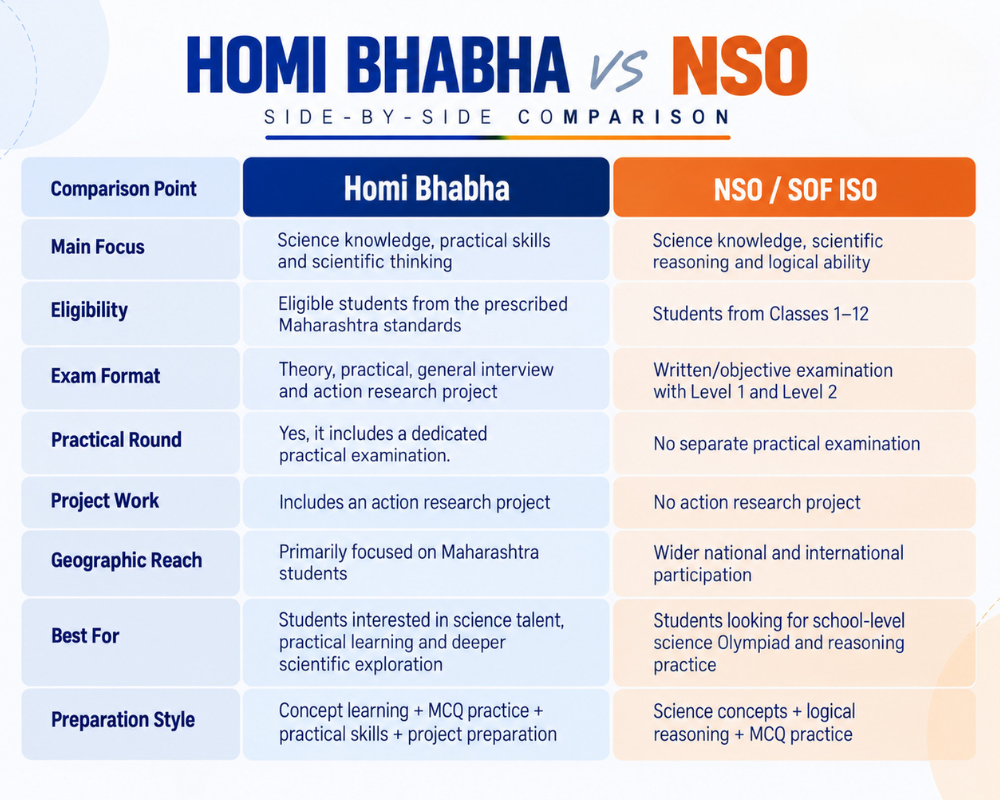
Homi Bhabha vs NTSE: Are They the Same Type of Exam?
No, Homi Bhabha and NTSE are not the same type of examination.
The Dr. Homi Bhabha Balvaidnyanik Competition is to encourage scientific curiosity, problem-solving and scientific talent among students. It is for students studying in Standard VI and IX with exam of four stages.
The National Talent Search Examination (NTSE) was a national-level talent search and scholarship examination conducted by NCERT instead of a science-specific competition. It assesses students through mental ability and scholastic aptitude components like science, mathematics and social sciences.
Key Differences
|
Homi Bhabha |
NTSE |
|
It focuses on science talent and scientific thinking. |
It identifies academic talent and provides scholarships. |
|
This is primarily science-focused. |
This covers mental ability & broader scholastic aptitude. |
|
It includes theory, practical, interview and action research |
It is primarily a written assessment. |
|
Students of classes 6 & 9 of Maharashtra as well as other states can also participate. |
It is a national-level talent search where class 10 students from any state can participate. |
|
It provides science competition and talent-development exposure. |
It was associated with scholarship support. |
Which Science Olympiad Should Maharashtra Students Choose?
The right science Olympiad for Maharashtra students depends on their interests, preparation style and academic goals. Comparing the exam format, skills and learning opportunities, they can make the best decision for themselves.
Which One Should You Choose? (Decision Box)
|
Choose Homi Bhabha if:
Choose NSO/ISO if:
Consider advanced Olympiads if:
|
A Quick 5-Question Test To Decide Before You Register
Ask yourself these five questions before choosing:
- Do I enjoy practical experiments as much as solving questions?
If the answer is yes, Homi Bhabha is a better fit. - Can I focus on science MCQs and reasoning?
Yes, NSO/ISO could match your preparation style. - Am I comfortable with interviews and project work?
If yes, Homi Bhabha offers a broader assessment experience. - Do I want to compete in a school-level science Olympiad or pursue an advanced Olympiad?
Your answer can help narrow down the right competition. - Does the competition’s eligibility match my class and goals?
Always check the current eligibility rules before registering.
How to Prepare Without Burning Your Child Out
Good preparation does not mean studying for hours every day. A simple disciplined routine can boost your confidence while leaving enough time for school, hobbies and some other tasks.
- Start with regular practice sessions.
- Focus on concepts before memorizing answers.
- Mix MCQs, practical activities and revision for a better outcome.
- Use previous papers to spot weak areas before the final exam.
- Keep one rest day each week.
- Increase practice gradually as the exam gets closer.
- Set small daily goals instead of long study hours.
- Take short breaks between practice sessions to stay active the whole time.
- Revise mistakes as well as difficult topics regularly.
- Keep the final weeks for revision as well as mock tests.
How Nitome Can Help You Prepare for the Homi Bhabha Science Olympiad
We bring different preparation tools together in one digital learning platform. Students can use these features to practise, review their performance and understand where they need more work.
You can choose Nitome because we provide:
- Digital Workbooks: Practice science questions through structured digital workbooks.
- Practice Tests: Attempt tests to regularly check your preparation.
- Score Reports: Review your test performance and track your scores.
- Topic-Wise Analysis: Identify topics that need more attention.
- AI-Powered Explanations: Get explanations to help understand questions and answers
Final Note
There is no one-size-fits-all choice when it comes to science competitions. The best option is the one that matches a student’s class and interests. For eligible students, Homi Bhabha provides a broader experience, whereas the other Olympiads are better for students that prefer different exam formats or levels of competition. Understanding these differences can help students register with a clear purpose.
Ready to prepare smarter for the Homi Bhabha Science Olympiad? Explore Nitome for focused practice and better exam preparation.
Frequently Asked Questions
1. Is Homi Bhabha harder than other Science Olympiads?
The difficulty depends on various factors. Homi Bhabha includes theory, practical, interview and project stages.
2. What skills does the Homi Bhabha competition test?
It tests:
- Scientific knowledge
- Observation skills
- Problem-solving
- Practical skills
- The ability to apply science concepts
3. How should students prepare for Homi Bhabha in 2026?
Students should build a strong foundation of science concepts and should practice MCQs along with mock tests as well as previous year papers so that weak areas can get assessed.