Dr. Homi Bhabha Balvaidnyanik Competition Sample Papers: Free Practice Guide
If you are preparing for the competition, practicing with relevant questions can help you build confidence and become familiar with the examination pattern. Dr. Homi Bhabha Balvaidnyanik Competition sample papers help you assess your subject knowledge, identify areas that need improvement and become familiar with different question formats.
By Chaitanya Vaze
Chaitanya Vaze is a leading educator and author with 26 years of experience in mentoring students for the Dr. Homi Bhabha Young Scientist Exam. Based in Dombivali, he runs a premier guidance center for Homi Bhabha, Scholarship, Olympiad, and NMMS exams. He is widely recognized for his "complete toolkit" approach to science, including: Author of 15+ Books: Creator of the definitive Theory and Practical science Handbooks for Std. 6th and 9th. Practical Innovation: Developer of "Smart Kits" that help students master the Level 2 Practical Exam at home. Latest Release: He is currently authoring the newest editions for Year 6 & 9, featuring updated practice questions and concise learning summaries (launching next month!).
Table of Contents:
Introduction
What Is The Dr. Homi Bhabha Balvaidnyanik Competition?
What Do Dr. Homi Bhabha Balvaidnyanik Competition Sample Papers Include?
Free Homi Bhabha Sample Papers: Where To Find Them
Why Sample Papers Matter More Than Extra Books
8 Types of Homi Bhabha Practice Questions Every Student Should Solve
How to Take a Home Bhabha Mock Test at Home (The 5-Step Method Toppers Follow)
8-Week Preparation Plan
Common Mistakes Parents Make
How Nitome Helps Your Child Prepare
Final Word
Frequently Asked Questions
Key Takeaways
|
You might know your science concepts well, but can you apply them correctly when the examination clock is ticking? That is where preparation makes all the difference.
If you are preparing for the competition, practicing with relevant questions can help you build confidence and become familiar with the examination pattern. Dr. Homi Bhabha Balvaidnyanik Competition sample papers help you assess your subject knowledge, identify areas that need improvement and become familiar with different question formats.
You can also use Homi Bhabha's previous year's papers to strengthen your preparation. This blog covers free practice resources, different question types, mock test strategies, an 8-week preparation plan and common mistakes parents should avoid.
What Is The Dr. Homi Bhabha Balvaidnyanik Competition?
The Dr. Homi Bhabha Balvaidnyanik Competition is a science competition organized by the Mumbai Science Teachers' Association (MSTA) to encourage scientific curiosity and interest among school students. It is for students studying in standards 6 and 9. It follows a four-stage format including a written examination, practical examination, general interview and activity-based assessment.
What Do Dr. Homi Bhabha Balvaidnyanik Competition Sample Papers Include?
Before downloading any Dr. Homi Bhabha Balvaidnyanik Competition sample papers, it is important to know what you are preparing for. These papers cover science concepts relevant to the respective class along with selected topics from previous academic standards.
The first stage of the examination is a 100-mark MCQ paper with 100 questions to be completed in 90 minutes. The syllabus also includes science-related general knowledge, so students need to look beyond their regular textbook exercises.
At last, choose separate practice material for Class 6 and Class 9 so your preparation stays relevant to your grade.
Free Homi Bhabha Sample Papers: Where To Find Them
Looking for free Dr. Homi Bhabha Balvaidnyanik Competition sample papers? Before downloading random PDFs, prefer reliable sources that provide relevant examination material. The MSTA is a good place to begin your search.
Here are a few ways to find useful practice resources:
- Visit the official MSTA website: Check the MSTA Homi Bhabha examination page for competition-related information and available resources.
- Check previous year's question papers: Check the MSTA Students Corner for available previous year question papers and corresponding answer keys.
- Choose papers according to your class: Make sure you download the correct material for Class 6 or Class 9 as the syllabus and difficulty level differ.
- Look for answer keys and explanations: A question paper becomes more useful when you can check your answers and understand why an option is correct.
- Explore additional online practice resources: Use educational platforms like NITOME to access structured question sets, practise science concepts and identify areas that need more attention.
Why Sample Papers Matter More Than Extra Books
Buying more science books does not always mean better preparation. What matters is how effectively you can apply those concepts when solving examination-style questions.
Homi Bhabha sample papers give you an opportunity to test your understanding by working with different question formats and recognize concepts you find difficult.
Even simply reading another chapter, solving a paper shows where they stand and where they need improvement. It also helps you to manage time so that you can become comfortable with the examination format.
Quick Tip: Instead of collecting more books, encourage your child to practice regularly and learn from every attempt.
|
Done revising? Now it is time to put that science knowledge to the test. Give Homi Bhabha practice tests a try and see how ready you really are! |
8 Types of Homi Bhabha Practice Questions Every Student Should Solve
Not every science question tests the same skill. Some check how well you understand a concept, while others ask you to observe, analyse or apply what you have learned. While solving Homi Bhabha practice questions, students become familiar with different question formats. Here are eight types worth including in your preparation.
1. Concept-based questions:
These questions assess your understanding of fundamental scientific principles, definitions and concepts. You focus on understanding why something happens rather than memorising textbook lines.
2. Application-based questions:
These questions connect science concepts with situations you see in everyday life. You need to apply your knowledge of heat, light or force to explain a common observation.
3. Logical reasoning questions:
They require you to think carefully, identify patterns and connect different pieces of information. You read each option closely before selecting your answer.
4. Observation-based questions:
These questions test how well you notice changes and interpret what you see. You are asked to identify patterns in natural events, everyday objects or scientific observations.
5. Experiment-based questions:
You focus on scientific experiments including their procedures, materials and outcomes. Here you understand why each step is performed.
6. Diagram-based questions:
These questions use scientific diagrams to test your understanding of structures, processes and different components. Practice identifying labelled parts and understanding how they function.
7. Scientific general knowledge questions:
They cover scientific discoveries, famous scientists, inventions, space, nature and important developments in science. Reading age-appropriate science-related information can help broaden your knowledge.
8. Numerical and data interpretation questions:
These questions involve basic calculations, measurements, tables, graphs or numerical information. Practise understanding the given data and selecting the correct answer without spending too much time on one question.
Expert TipDo Not Just Count Your Correct Answers! Getting 70 questions right is great but understanding why the other 30 went wrong is more important. Review every mistake before moving to your next practice paper. |
How to Take a Home Bhabha Mock Test at Home (The 5-Step Method Toppers Follow)
Taking a Homi Bhabha mock test at home can help students understand their preparation level before the actual examination. But simply solving questions and checking the final score is not enough. Follow these five steps to make every mock test count.
|
Steps |
Headings |
Description |
|
Step 1 |
Finish the Topic First |
Go through important concepts, definitions and examples so you can test your understanding rather than guess the answers. |
|
Step 2 |
Attempt It in Exam Conditions |
Set a timer for 90 minutes and attempt a full-length paper with 100 questions. Keep your notes and mobile phone aside to create an exam-like environment. |
|
Step 3 |
Check the Answers Together |
Once the test is complete, compare your responses with the answer key. If the answer is wrong, see the mistake closely. |
|
Step 4 |
Sort Mistakes Into Three Boxes |
Concept gaps: You do not understand the topic. Careless mistakes: You misread or answer in a rush. Time-related mistakes: Left unanswered or done in a hurry. |
|
Step 5 |
Fix & Re-Attempt After 7 Days |
Spend the next few days revising weak concepts and practicing similar questions. After seven days, attempt the incorrect questions again without seeing answers. |
8-Week Preparation Plan
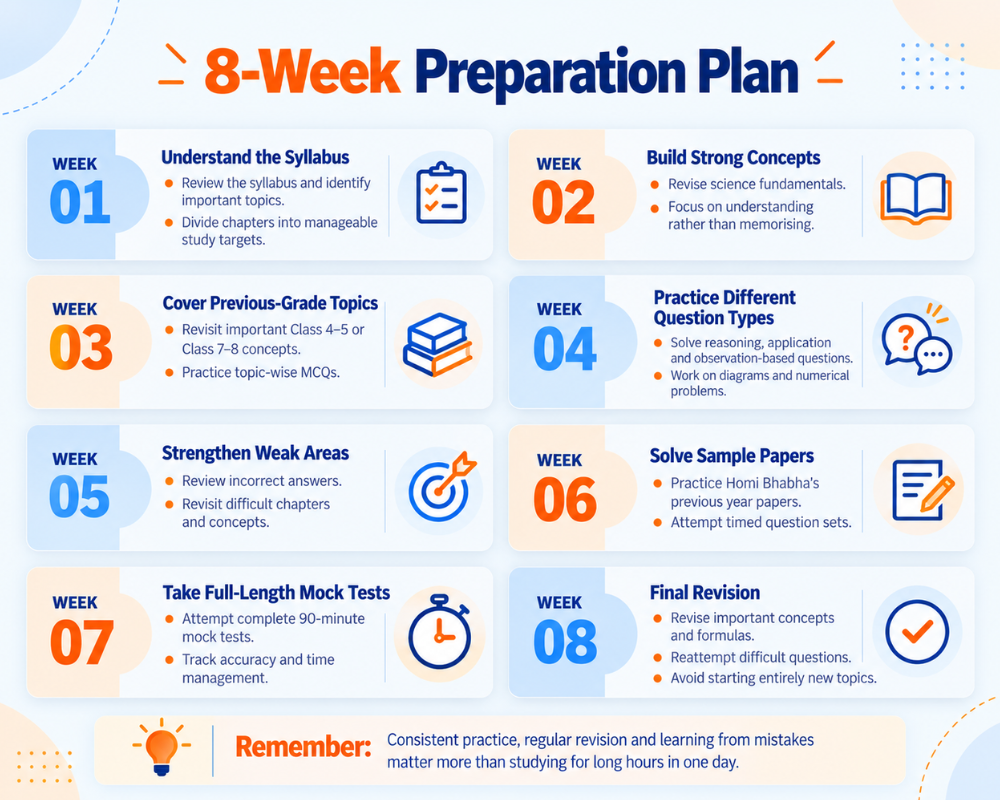
Week 1 – Understand the Syllabus
- Review the syllabus and identify important topics.
- Divide chapters into manageable study targets.
Week 2 – Build Strong Concepts
- Revise science fundamentals.
- Focus on understanding rather than memorising.
Week 3 – Cover Previous-Grade Topics
- Revisit important Class 4–5 or Class 7–8 concepts.
- Practice topic-wise MCQs.
Week 4 – Practice Different Question Types
- Solve reasoning, application and observation-based questions.
- Work on diagrams and numerical problems.
Week 5 – Strengthen Weak Areas
- Review incorrect answers.
- Revisit difficult chapters and concepts.
Week 6 – Solve Sample Papers
- Practice Homi Bhabha's previous year papers.
- Attempt timed question sets.
Week 7 – Take Full-Length Mock Tests
- Attempt complete 90-minute mock tests.
- Track accuracy and time management.
Week 8 – Final Revision
- Revise important concepts and formulas.
- Reattempt difficult questions.
- Avoid starting entirely new topics.
Remember: Consistent practice, regular revision and learning from mistakes matter more than studying for long hours in one day.
Common Mistakes Parents Make
Parents play an important role in their child's preparation but sometimes well-intentioned decisions can make learning more stressful. Here are some common mistakes to avoid:
- Relying only on textbooks instead of including MCQ & sample paper practice.
- Buying too many reference books without following a structured study plan.
- Focusing only on test scores rather than understanding mistakes.
- Ignoring important science concepts from previous grades.
- Leaving sample paper practice until the last few weeks.
- Comparing a child's preparation and performance with other students.
- Overloading children with study sessions and leaving little time for breaks.
- Neglecting practical experiments, observations and hands-on learning.
Parent’s CornerBe Their Study Partner, Not Their Examiner! Instead of asking, "How many marks did you get?" try asking, "What interesting thing did you learn today?" A little encouragement can make preparation more enjoyable. |
How Nitome Helps Your Child Prepare
Preparing for the Dr. Homi Bhabha Balvaidnyanik Competition requires more than reading science textbooks. Students need opportunities to practice questions, assess their performance and understand their mistakes. NITOME offers an online learning platform with dedicated practice tests to support students in their preparation.
This is how NITOME's features can help:
- Online Practice Tests: Practice with dedicated Homi Bhabha competition tests.
- Digital Workbooks: Access workbooks for additional practice.
- Score Reports: Review scores & track performance.
- Topic-Wise Analysis: Identify strengths and weaker topics.
- AI-Powered Explanations: Understand questions and answers with AI support.
- Expert-Led Learning Resources: Learn through courses created by expert educators.
Final Word
Preparing for the Dr. Homi Bhabha Balvaidnyanik Competition is not only about studying more but it is also about practicing smarter. The right Dr. Homi Bhabha Balvaidnyanik competition sample papers can help students to understand question patterns, improve accuracy and identify topics that need more attention. It is best to make a proper schedule for regular MCQ practice, previous year papers and mock tests instead of leaving everything until the last minute.
Give your child the confidence to approach every science question with curiosity and clarity. Explore NITOME's Dr. Homi Bhabha Balvaidnyanik Competition practice tests and help them make every practice session count!
Frequently Asked Questions
Q. Are Homi Bhabha sample papers for class 6 & class 9 available for free in 2026?
Yes, students can find free previous year question papers and answer keys through available MSTA resources. They can also use online educational platforms for additional class-wise practice.
Q. How many mock tests should I solve before the Homi Bhabha examination?
There is no fixed number but try to solve at least 5–8 full-length mock tests while reviewing mistakes after every attempt.
Q. Can I prepare for the Homi Bhabha competition without coaching?
Yes, students can prepare independently by following a consistent study routine using school textbooks, previous year papers, sample papers and regular mock tests.